Three things Pokemon Go reminds us about journalism

FullSizeRender
  I had some help writing this post.

In case you missed my two posts celebrating feminism in the Star Wars universe, let me issue this disclaimer: I’m a geek, something that predated – by decades – the mainstream coolness of Comic-Con, Peggy Carter and Mr. Spock.

Pokemon, though, was never my scene. Too many rules. Too many obnoxious noises. Too many cartoon creatures teetering between adorable and terrifying.

Still, I joined millions of other people in downloading the app last weekend, motivated not by nostalgia but by curiosity about augmented reality and how it might change the way we tell stories. After several days as a Pokemon trainer, I have a lot to think about in terms of AR. I was also reminded of three truths about journalism:

1.) Look for layers. Augmented reality superimposes information over physical space. (Great explainer here about AR and the origins of Pokemon Go.)  Playing the game requires exploring its digital landscape, a process that can teach us about our surroundings. For instance: I discovered a couple of local historical markers while stocking up on Poke Balls last night. Finding and telling news stories also requires shifting the way you see the world, looking for different lenses through which to view our communities. Practicing journalism and experiencing AR both require embracing new ways of seeing.

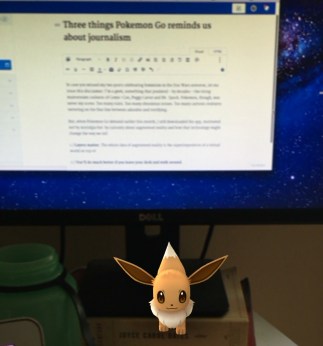
2.) You’ll do much better if you leave your office and walk around. Sure, the occasional wild Eevee wanders across my desk, but I’ve caught more – and more diverse – Pokemon while walking my dog or chatting up people downtown. Reporters also find richer, more interesting stories by roving around and talking to people face to face. I know email is a journalistic necessity, but human contact is always better. Besides, my inbox has yet to yield a single Bellsprout, Jynx or Rattata.

3.) Verify everything. In the days after Pokemon Go’s launch, my Facebook feed was awash with headlines reporting the game’s dire consequences: murders, car accidents, exposure to Satanic rituals. Most of that stuff is bogus, something we know thanks to websites like Snopes.com. It’s crucial for journalists to engage in this kind of debunking in a world where falsehoods evolve as quickly as a Jigglypuff hopped up on candy. (For the uninitiated: Sugar makes a wild Pokemon morph into a larger and slightly fiercer version of itself. Or something like that. I’m new here, remember? Here’s more from a far more credible source.)

Now, if you’ll excuse me, I think I hear a Pidgey in my attic.

How serving as a Pulitzer juror made me a better journalism teacher

Being invited to serve on a Pulitzer jury is probably a little like getting accepted to Hogwarts: You receive a letter written on really nice stationary with instructions to show up at a certain place and time. And please, it goes on, don’t tell anyone what you’re up to.

My envelope from Hogwarts has, alas, never arrived, but for the second year in a row I was summoned to Columbia University in February to serve as a Pulitzer juror, picking finalists in one of 14 journalism categories.  Last winter, I sat on the local reporting jury. (Details on that experience here.) This time was breaking news.

Pulitzer deliberations are confidential, and jurors’ identities are secret until after the winners are revealed, but my experience has still been a powerful teaching tool, one that’s given me fresh vocabulary to describe what it means to master the craft of modern nonfiction storytelling.

My students have been poking around the new Pulitzer website for a couple of months, identifying strong leads and mulling over what topics make compelling stories. We also talked a bit about the Pulitzers and public service journalism ahead of our Spotlight event earlier this month.

Last week, my editing class watched the announcement of the 2016 winners live:

CgWM4MqXEAA7E6z

Then we examined the winner and finalists in the breaking news category and talked about the hallmarks of effective, responsible journalism in the first few hours of a big story. The students liked how the Los Angeles Times’s winning entry used rumor-busting bullet points to list known facts after the San Bernardino shootings. They found the Baltimore Sun’s interactive timeline useful in understanding the events that led to Freddie Gray’s death. We also talked about how the Post and Courier used a mix of screen grabs to illustrate a video showing the shooting of Walter Scott. (When it came to whether or not to publish the video itself, the students’ opinions were mixed.)

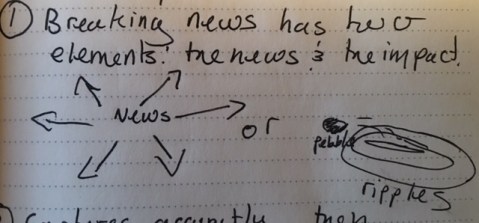
All three entries show a mix of urgency and comprehensive follow up. Here’s a little scribble that I used to illustrate this concept:

FullSizeRender (1)

In the hours, days and even months after a major breaking news event, readers want – need – coverage that provides context, answers questions and explores possible solutions. Accuracy matters more than speed. Or, as I told my students, it’s better to be dead last than dead wrong.

These Pulitzer-inspired lessons will continue in the fall, too. My colleague Tom Haines is teaching a course focused on environmental reporting, and his students will be able to learn from finalists like InsideClimate News, the Portland Press Herald and ProPublica. I’m teaching entrepreneurial journalism, and we’ll talk about how several of this year’s top entires came from news organizations that didn’t exist a decade ago.

So thanks, Pulitzers. And happy 100th birthday. Here’s hoping for another century of identifying and honoring excellence in journalism.

Learning from “Spotlight”

robbyandme
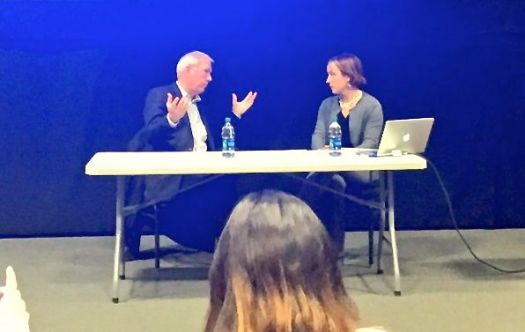
The Boston Globe’s Walter Robinson and I prepare to chat about investigative journalism Tuesday night at UNH. Photo credit/Hadley Barndollar.

During one of the opening scenes in Spotlight, Walter Robinson (as portrayed by Michael Keaton) uses the term “player-coach” to describe his role as editor of the Globe’s famed investigative team. That characterization is accurate – something I know after working as Robinson’s teaching assistant at Northeastern University.

At the time, Robinson was running NU’s investigative journalism program, teaching students how to dig up stories about gun policies at community colleges, racial disparities in Boston firehouses and more. He’s a master at teaching by doing, and, by watching him, I learned as much about running a classroom as I did about mining documents and cultivating sources. (Robinson is back at the Globe now, and NU’s investigative work continues thanks to longtime TV journalist Mike Beaudet.)

It was an honor to interview Robinson in front of an (over) packed room at UNH earlier this week. We talked for an hour or so about the investigation that inspired the Spotlight movie, the importance of access to public information and why knocking on doors is a better reporting technique than sending emails.

Robinson’s visit was the culmination of a series of lessons built around the Spotlight film. And, judging by the conversations I’ve had with students over the last few days, lots of them are inspired to dig just a little deeper on their next stories.