Learning about solutions journalism

I spent most of Monday at a workshop on solutions journalism. It was a lovely start to the week for more than one reason. We met at the NH Audubon’s Concord property, which meant we got to see this gorgeous creature during a coffee break. More important, though, was the chance to explore a sub-genre that I’ve been curious about for several years.

Our leader was Tina Rosenberg, a Pulitzer Prize winner and co-founder of the Solutions Journalism Network, a group that aims to increase the “volume and quality” of this type of storytelling. We spent time discussing what Solutions journalism is and isn’t, but here’s one definition I like a lot:

Solutions journalism can include reporting on responses that are working, partially working, or not working at all but producing useful insights. We can learn just as much from a failure as a success. The key is to look at the whole picture — the problem and the response. Journalism often stops short of the latter.

The notion that this type of storytelling is about presenting a more complete, complex picture is important. I also appreciate the emphasis Rosenberg places on finding compelling characters and structuring “howdoneit” narratives that keep the reader engaged.

I took a lot of notes on Twitter throughout the day. Some highlights:

For examples of solutions journalism, check out these projects.

I was a Pulitzer juror and here’s what I learned about great journalism

Reporters aren’t very good at keeping secrets, but I’ve managed to stay mum for a couple of months about some exciting professional news: I was one of roughly 100 jurors who vetted nominees for the 2015 Pulitzer Prizes. For three days in February, I sat hunched over a table at Columbia University’s journalism school reading page after page of powerful work.

I was assigned to the local reporting category, so I saw projects produced by newsrooms of all shapes and sizes. The details of Pulitzer jury deliberations are secret, but the experience gave me lots to think about in terms of what it means to practice excellent journalism. There’s no universal checklist, but the winners that were announced last week shared four common factors I’ve tried to summarize here:

Pulitzer_elements1.) Top-notch journalism relies on three elements: diverse human voices, bulletproof verification and technical proficiency with both language and digital tools. I came to think of it as a stool with three legs similar to the one pictured to the left. This mix is apparent in many of the winning entries, but it’s especially effective in the collection of columns that won the Pulitzer for editorial writing. Kathleen Kingsbury of The Boston Globe explored how the booming restaurant business often fails to provide living wages for kitchen workers. Kingsbury uses crisp writing to blend the experiences of these workers with extensive research into economics, labor laws and more.

2.) The rise of digital publishing means journalists have dozens of new tools — and those tools should be used in a way that serves the audience and the story. Video, interactive games and other multimedia features should rise above flashy window dressing to enhance readers’ understanding. Effective multimedia doesn’t have to be expensive, either. The newsroom that won in the local reporting category used open-source tools like Timeline JS to help the community follow a long and complex investigation into corruption at a school district in California.

3.) Strong verbs make confusing topics comprehendible. Zachary R. Mider of Bloomberg News won the Pulitzer in explanatory reporting for his work on tax-dodging corporations. It’s complicated, abstract stuff, but Mider’s lively writing makes it easy to understand. Take, for instance, this story about one particular manufacturing company. Mider builds his lead around verbs like “forged” and “carved” and “sparked.” Such words carry the reader into the piece. He also uses a nice mix of short, medium and long sentences that rely on precise, plain language instead of headachy jargon.

4.) There’s strength in numbers. Many of the winning entries were produced by teams of reporters. In some cases, newsrooms also had outside assistance. A good example is The Post and Courier in Charleston, South Carolina where four journalists won the Pulitzer for public service for their investigation into the state’s high rate of domestic violence. The newsroom received technical, editing* and financial support from the Center for Investigative Reporting; that partnership yielded a database used to identify trends in domestic violence fatalities. Some of that information appears throughout the online version of the investigation — a collection of multimedia narratives that also required teamwork to build. This is a reminder that, while writing is often a solitary task, modern journalists must hone their interpersonal skills the same way they practice storytelling.

Finally, here’s a tip for anyone applying for jobs: White space matters. Each Pulitzer entry includes a nomination letter introducing the project to the jury. That means I read dozens of them in the space of a few hours. The ones with clean fonts and line breaks between the paragraphs were easiest on the eyes. Small details, I know, but both are techniques every new (and not-so-new) journalist should consider when writing cover letters to potential employers.

* Post updated 5/4/2015 to more precisely reflect the Center for Investigative Reporting’s role in the project. More details about the partnership here

Service, solutions and theology in local journalism

IMG_1007.JPG

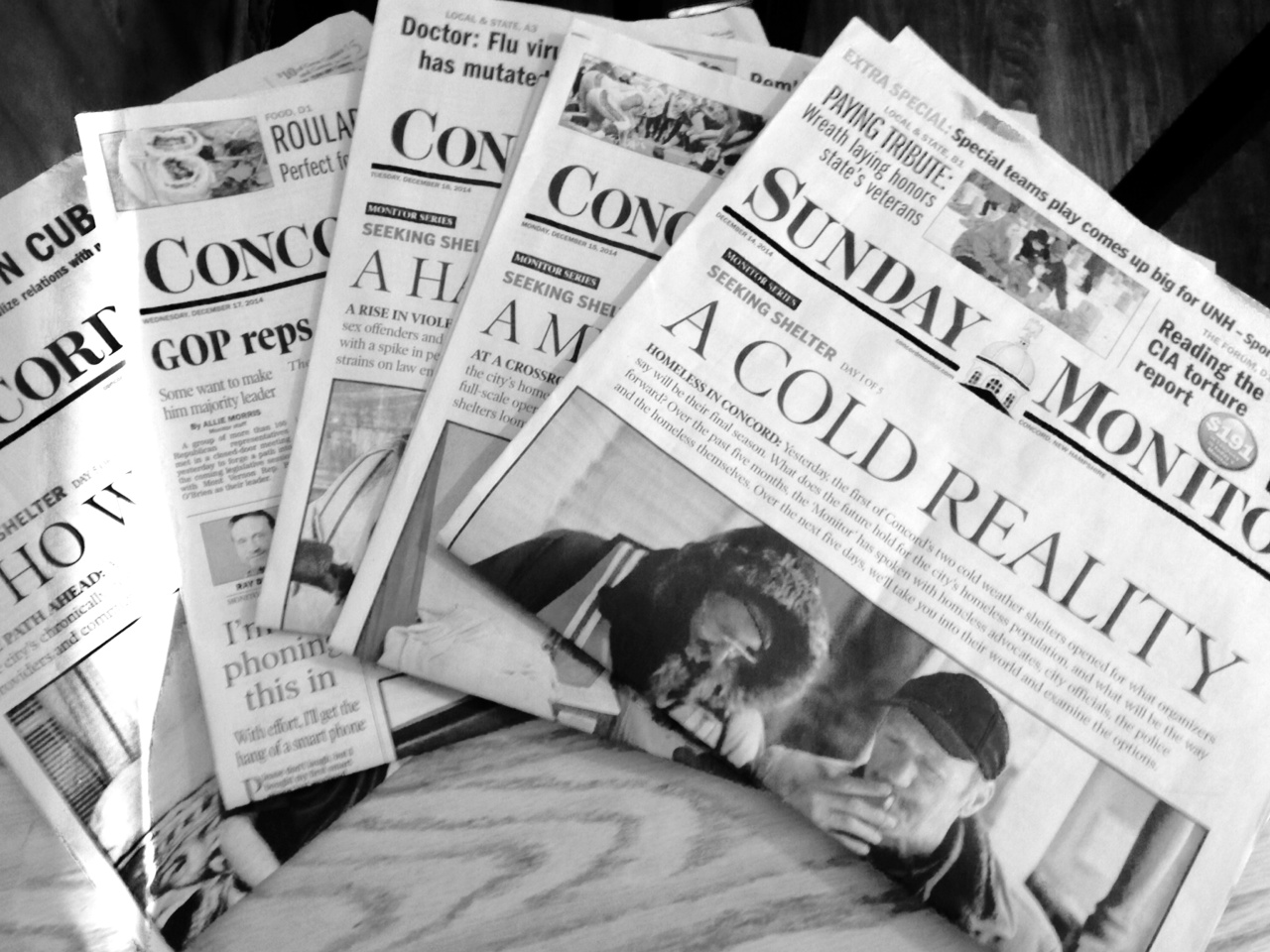
I spend a handful of nights each winter in the basement of a downtown church, pouring coffee and passing out dry socks to men and women with nowhere else to go. I’m among the hundreds of volunteers who, for the last decade, have helped operate a cold weather homeless shelter in Concord, NH.

The people we serve there have been the focus of a sweeping collection of stories, photos, graphics and videos published this week by the Concord Monitor*The series, called Seeking Shelter, has given me a lot to think about both in terms of homelessness and the role of local newspapers.

I’ve learned a lot during my volunteer shifts at the shelter, but the Monitor’s series has taught me more. The city, write reporters Jeremy Blackman and Megan Doyle, is at an “unprecedented moment” in its history:

Concord’s homeless population has been growing for years, driven by a mix of economic instability, rising substance abuse and geography. State and local police have broken up many of the encampments in town, following a number of violent incidents and several deaths.

Community leaders have long discussed finding a more permanent solution, but they’ll need to act fast. Come spring, the shelter where I volunteer and a second one at a neighboring church will shut down for good.

The Monitor has addressed homelessness in the past through daily stories, photos and editorials. But this week’s series takes its coverage to a new level, one that bodes well for the practice of local journalism.

In his book The Wired City, Dan Kennedy** asks, “Can journalism have a theology?” He uses that question to explore the motivations and professional philosophy of Paul Bass, the founding editor of the nonprofit New Haven (CT) Independent. That publication’s journalism, Kennedy writes, is

based on a community-driven vision of conversation, cooperation and respect. It is a vision that sounds a lot like that of many religious communities, and it is the opposite of the top-down, we-report/you-read-watch-or-listen model of traditional news organizations.

I’ve been reminded of this passage as I’ve watched the Monitor’s series unfold this week. All of the players – social workers, policymakers, clergy members and the homeless people themselves – are portrayed as human beings facing complex challenges. Photographers Geoff Forester and Elizabeth Frantz earned the trust of the homeless community in a way that allowed them to document the lives of people who often prefer to remain unseen.

Perhaps most importantly, though, the Monitor has explored possible solutions and invited public conversation. Much has been written about the concept of solutions journalism, and the Monitor’s work this week is a good example of the genre. The newsroom also created the hashtag #homelessinconcord to organize online discussion. Tonight, the paper’s editors will host a community dialogue at one of the shelters about the issues raised by the series.

Not that long ago, traditional journalists may have labeled this as something too close to advocacy. It’s not.

Instead, it’s the kind of thing news organizations must do to remain crucial parts of the communities they cover. Kennedy makes this argument in The Wired City, exploring how local editors like Bass can foster as well as cover civic life.

The Monitor isn’t immune to the financial and existential challenges facing newspapers, but this series is an indication that, to the journalists in its newsroom, simple survival won’t be enough. Local news organizations should practice the kind of storytelling happening at the Monitor this week. It will be hard. It will consume scarce resources. And it must happen. No matter what.

Can journalism have a theology?

Yes.

And it’s embodied in the kind of collaborative, socially just and human storytelling displayed by the Monitor this week.

*I worked at the Monitor for many years, and was a consulting editor there this summer. 

** Dan Kennedy was one of several fantastic faculty members who advised my graduate studies at Northeastern University last year.