The last few weeks, writ small

Someday (and I do hope it’s soon), I’ll figure out how to juggle teaching, freelancing and blogging. Until then, we’ll all just have to live with somewhat sporadic posting. Here’s a recap of what’s been going on in my world:

  • Dan Kennedy called me “smart.”  Kennedy is one of several brilliant journalists who guided my graduate studies at Northeastern University.  Earlier this fall, he interviewed me for this video about the future of local news.
  • One of this year’s most interesting Congressional races is unfolding in my backyard. The contest for New Hampshire’s CD2 is, in many ways, a microcosm of the narratives about race, gender and generational identity swirling around this election season. Here’s my story in the Boston Globe.
  • I got some student journalists hooked on politics. (#sorrynotsorry.) UNH co-hosted a debate between U.S. Sen. Jeanne Shaheen and Scott Brown earlier this month, and a group of journalism students got an up-close look at what it takes to organize that kind of event. Here are a few of the students leaving the debate hall to interview the supporters outside:
UNH journalism student Tom Spencer leads his classmates through the crowd outside the Capitol Center for the Arts in Concord, NH on Oct. 21, 2014. Photo/Meg Heckman

As of this writing, roughly 36 hours remain in the 2014 midterm elections. Here’s hoping for a more regular blogging schedule after that.

A new book on digital journalism and ethics

51JSmCXh6HL._BO2,204,203,200_PIsitb-sticker-v3-big,TopRight,0,-55_SX278_SY278_PIkin4,BottomRight,1,22_AA300_SH20_OU01_A couple of essays I wrote for the Center for Digital Ethics and Policy have been published in a new book called A Practical Guide to Digital Journalism Ethics. I examined the complicated journalistic questions that arise from social media curation and how building an online social network forced me to rethink traditional standards of objectivity.

Other writers tackle the ethics of anonymous commenting, photo manipulation and credibility questions surrounding amateur restaurant reviews. The book is available through Amazon for $9.99.

All politics is local (journalism)

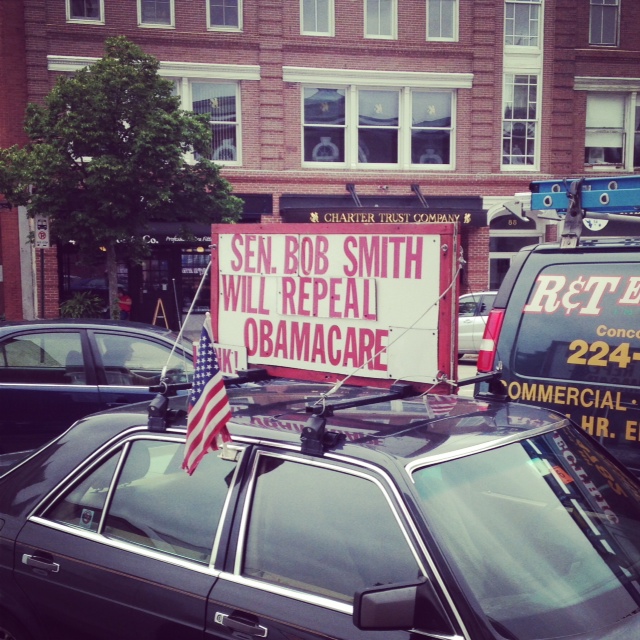
One of the many political opinions on display lately. Photo/Meg Heckman

It’s been a decade since the bitter cold winter when I started covering politics. Plenty of Democrats wanted a chance to unseat President George W. Bush, so New Hampshire was bustling with candidates. It was a rare stump speech that  didn’t reference 9/11, and most voters I met knew at least one person stationed in Iraq or Afghanistan. Everyone who turned out to hear the potential challengers or, later, the president himself believed that this election would somehow make things better.

Sure, politics has plenty of problems. There’s too much money. Too much celebrity. Too much disconnect between the loud debates and the everyday lives of most Americans. But the political process is also beautiful. A campaign is a microcosm of a community: coalitions, networks, passions that bring people together and drive them apart. In the months before an election, voters become more public with their anger, their fears, their hopes. They display their opinions on lawns, on car bumpers and with pins on their lapels. Collectively, we consider who we are to ourselves and who we want to be in the eyes of the world.

And, as a journalist on the campaign trail, it was my job to find them at their coffee shops and their town halls, flip open my notebook and listen.

When I decided on the career shift that would eventually land me a teaching job at UNH, I assumed I was done covering politics. I was wrong. Which is awesome. Because I really missed it.

Since early June I’ve been filing dispatches from New Hampshire for the Boston Globe’s new political section, a visually stunning effort called Capital that appears Fridays in print and throughout the week online. (Here’s Poynter’s take on the project, and a look at the section’s design philosophy.) Capital was great when it launched, and it’s only gotten better since then.

As for my own contributions, I’ve written about the new proprietor of an old political landmark, the GOP’s quest for a perfect site for the 2016 Republican National Convention and Bob Smith’s return to politics after a 12 year hiatus.

Tonight, I’m heading out to work on another piece, and I’m looking forward to hearing what stories New Hampshire’s voters have to tell.