
Vizzies I have loved

Matt Carroll, the Boston Globe’s data guru,  gave one of my classes a tutorial on Google Fusion last week. It was pretty awesome.

Carroll called data visualization an “exploding field” with a shortage of qualified  journalists. (Hear that, student journos? If you want a job you should learn a bit about data or at least spreadsheets.) I had hoped to post a vizzy of my own, but I’ve been bogged down in other projects these last few days. Instead, here’s a roundup of some impressive data visualizations I’ve seen lately:
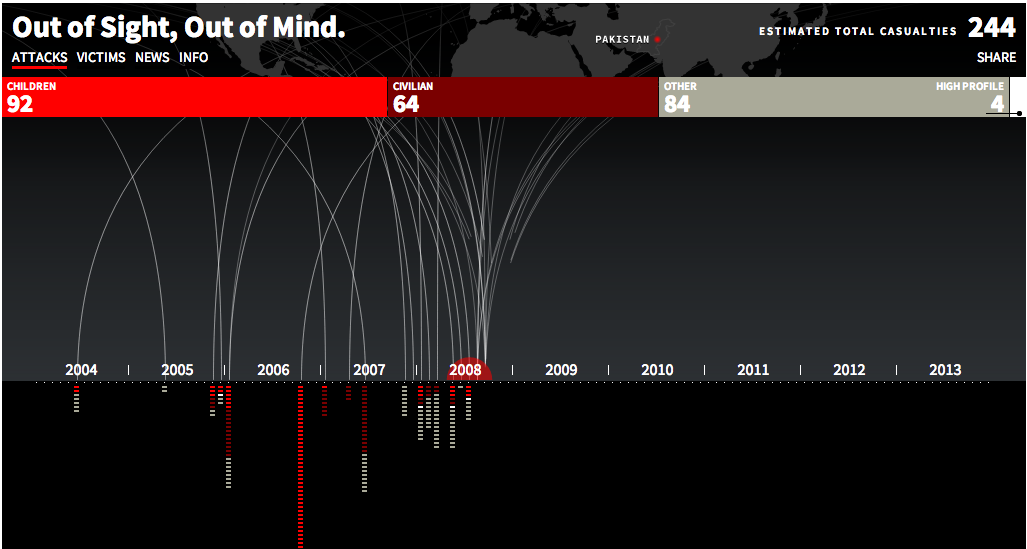
Drone warfare graphic from The Guardian's website.
In this interactive graphic, The Guardian breaks down drone strikes in Pakistan since 2004. Photo/guardian.co.uk

The Guardian’s Datablog is always amazing, but this animated, interactive look at drone warfare in Pakistan is in a class by itself. The designers used data from the Bureau of Investigative Journalism to illustrate the demographics of the more than 3,000 people killed by American drone strikes in Pakistan since 2004. The information is complex, but the design remains simple. A quick look shows how strikes became more frequent — and more deadly — after President Obama took office in 2009. Closer inspection reveals details about each attack.

Like the drone project, this graphic from the Associated Press is structured around a timeline. It uses colored circles the cost in terms of money and life of wars throughout American history. The AP published it today to mark the 40th anniversary of the end of American involvement in the Vietnam War. It’s simple, timely and contextualizes historic events.

ProPublica is packed with vizzies, including a few sophisticated enough to be reporting tools in their own right. One of my current favorites is this graph of where members of Congress stand on gun regulation. It’s a calm, clear look at an emotional topic. At first, I found all the little pictures distracting, but I came to appreciate them after playing with the graphic for a few minutes.

Who else is counting?

I launched this blog to help find meaning in the scads of information I’m gathering for my thesis, which is focused on the role of women in emerging online news organizations. My methodology is still in the works, but I’m lucky to have some fantastic research to build upon. Over the next few weeks, I’m going to create a literature review — a document that describes “the critical points of current knowledge” on a topic.

But it won’t be your typical lit review. There will be video, photos, maybe even an interactive graphic, all designed to help understand what data is available, who’s collecting it and — perhaps most importantly — why. I’ve written already about some of the sources I’ll cite, including this list of blogs and books, a public Zotero bibliography and a post about The Gender Report, a byline surveillance project that’s found an underpresentation of women in online news.

I’m also talking to the Columbia Journalism Review in hopes of gleaning some useful information from its fantastic Guide to Online News Startups. There’s also some interesting research happening at MIT and in conjunction with the Boston Globe’s innovation lab. One or both of those projects could make for interesting video.

Who else should I include?

On becoming a visual storyteller

It’s mid-March here in New Hampshire, which means several things: spring skiing, mud and town meeting — a centuries old form of direct democracy where eligible voters in a community gather annually to decide public matters. Should the town mandate recycling? Give the teachers a raise? Buy a new wing plow for the highway department?

It’s fantastic — especially if there’s a bake sale in the lobby.

I long ago lost track of the number of town meetings I’ve covered, but this was the first year I thought to document any part of the experience with photos. (My former colleagues in the Concord Monitor’s photo department, on the other hand, take town meeting visuals seriously.) But on Saturday morning, as I sat in the back corner of a sunny community center, I noticed how the light touched the pinstriped curtains on the voting booths. It was simple, beautiful and iconic.

Here’s the picture I took with my iPhone, toned up a bit with Instagram:

Road repair was the big issues at the 2013 town meeting in Northfield, NH. Photo/Meg Heckman
Road repair was the big issue at the 2013 town meeting in Northfield, NH. Photo/Meg Heckman

In the year since I joined Instagram, I’ve learned to see photos in my daily life. It grounds me, helps me notice details and write with a sense of place.  Sometimes I’ll take a picture of an item I want to describe in words later on or share a moment on Twitter or Facebook like something out of a visual reporter’s notebook. It’s immediate, provisional and accessible.

This kind of thinking is crucial to modern journalism. As this piece on Poynter.org points out, “the web is a visual medium.”

It didn’t start that way, back when HTML truly was all about marking up text. Over the years, though, the options for shaping the appearance of a Web page have grown more plentiful and sophisticated.

Now, of course, Web producers have a wide range of design tools at their disposal. Color, typography, imagery, positioning and many more design elements can be tuned to exacting detail. Emerging technologies like CSS3 and HTML5 make it easy to implement these visual ideas.

In the right hands, an array of design choices can produce impressive results. Misapplied, they can create a visual cacophony.

Effectively using visual elements has been a challenge as I’ve evolved from writer to post-platform storyteller, but so worth the effort. I love the idea of grabbing whatever tool will best tell a story organically. Pen and notebook. DSLR camera. iPhone. Sound kit. Data visualization software. All of the above — or something we have yet to imagine.

It’s an overwhelming prospect at first, but, done right, one that allows us to create the kind of narratives in which, as Ken Burns says, one plus one equals three.