Being invited to serve on a Pulitzer jury is probably a little like getting accepted to Hogwarts: You receive a letter written on really nice stationary with instructions to show up at a certain place and time. And please, it goes on, don’t tell anyone what you’re up to.
My envelope from Hogwarts has, alas, never arrived, but for the second year in a row I was summoned to Columbia University in February to serve as a Pulitzer juror, picking finalists in one of 14 journalism categories. Last winter, I sat on the local reporting jury. (Details on that experience here.) This time was breaking news.
Pulitzer deliberations are confidential, and jurors’ identities are secret until after the winners are revealed, but my experience has still been a powerful teaching tool, one that’s given me fresh vocabulary to describe what it means to master the craft of modern nonfiction storytelling.
My students have been poking around the new Pulitzer website for a couple of months, identifying strong leads and mulling over what topics make compelling stories. We also talked a bit about the Pulitzers and public service journalism ahead of our Spotlight event earlier this month.
Last week, my editing class watched the announcement of the 2016 winners live:

Then we examined the winner and finalists in the breaking news category and talked about the hallmarks of effective, responsible journalism in the first few hours of a big story. The students liked how the Los Angeles Times’s winning entry used rumor-busting bullet points to list known facts after the San Bernardino shootings. They found the Baltimore Sun’s interactive timeline useful in understanding the events that led to Freddie Gray’s death. We also talked about how the Post and Courier used a mix of screen grabs to illustrate a video showing the shooting of Walter Scott. (When it came to whether or not to publish the video itself, the students’ opinions were mixed.)
All three entries show a mix of urgency and comprehensive follow up. Here’s a little scribble that I used to illustrate this concept:
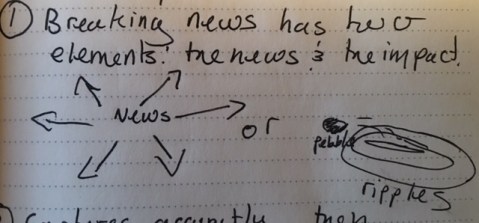
In the hours, days and even months after a major breaking news event, readers want – need – coverage that provides context, answers questions and explores possible solutions. Accuracy matters more than speed. Or, as I told my students, it’s better to be dead last than dead wrong.
These Pulitzer-inspired lessons will continue in the fall, too. My colleague Tom Haines is teaching a course focused on environmental reporting, and his students will be able to learn from finalists like InsideClimate News, the Portland Press Herald and ProPublica. I’m teaching entrepreneurial journalism, and we’ll talk about how several of this year’s top entires came from news organizations that didn’t exist a decade ago.
So thanks, Pulitzers. And happy 100th birthday. Here’s hoping for another century of identifying and honoring excellence in journalism.
 Meg Heckman