Learning from “Spotlight”

robbyandme
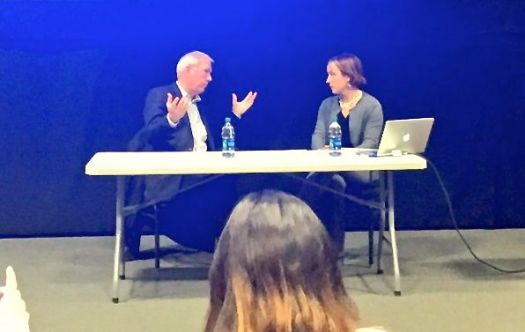
The Boston Globe’s Walter Robinson and I prepare to chat about investigative journalism Tuesday night at UNH. Photo credit/Hadley Barndollar.

During one of the opening scenes in Spotlight, Walter Robinson (as portrayed by Michael Keaton) uses the term “player-coach” to describe his role as editor of the Globe’s famed investigative team. That characterization is accurate – something I know after working as Robinson’s teaching assistant at Northeastern University.

At the time, Robinson was running NU’s investigative journalism program, teaching students how to dig up stories about gun policies at community colleges, racial disparities in Boston firehouses and more. He’s a master at teaching by doing, and, by watching him, I learned as much about running a classroom as I did about mining documents and cultivating sources. (Robinson is back at the Globe now, and NU’s investigative work continues thanks to longtime TV journalist Mike Beaudet.)

It was an honor to interview Robinson in front of an (over) packed room at UNH earlier this week. We talked for an hour or so about the investigation that inspired the Spotlight movie, the importance of access to public information and why knocking on doors is a better reporting technique than sending emails.

Robinson’s visit was the culmination of a series of lessons built around the Spotlight film. And, judging by the conversations I’ve had with students over the last few days, lots of them are inspired to dig just a little deeper on their next stories.


Service, solutions and theology in local journalism

IMG_1007.JPG

I spend a handful of nights each winter in the basement of a downtown church, pouring coffee and passing out dry socks to men and women with nowhere else to go. I’m among the hundreds of volunteers who, for the last decade, have helped operate a cold weather homeless shelter in Concord, NH.

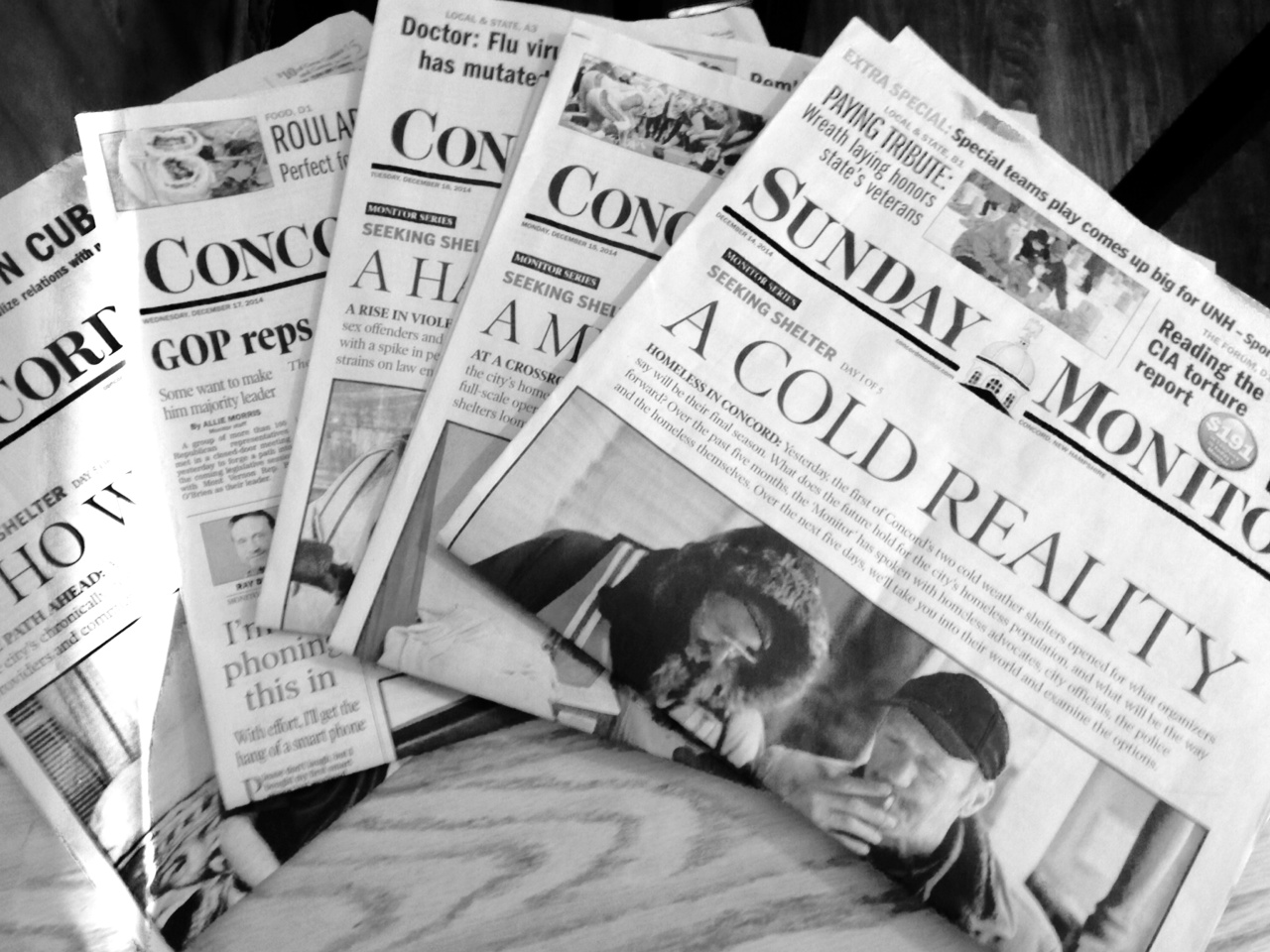
The people we serve there have been the focus of a sweeping collection of stories, photos, graphics and videos published this week by the Concord Monitor*The series, called Seeking Shelter, has given me a lot to think about both in terms of homelessness and the role of local newspapers.

I’ve learned a lot during my volunteer shifts at the shelter, but the Monitor’s series has taught me more. The city, write reporters Jeremy Blackman and Megan Doyle, is at an “unprecedented moment” in its history:

Concord’s homeless population has been growing for years, driven by a mix of economic instability, rising substance abuse and geography. State and local police have broken up many of the encampments in town, following a number of violent incidents and several deaths.

Community leaders have long discussed finding a more permanent solution, but they’ll need to act fast. Come spring, the shelter where I volunteer and a second one at a neighboring church will shut down for good.

The Monitor has addressed homelessness in the past through daily stories, photos and editorials. But this week’s series takes its coverage to a new level, one that bodes well for the practice of local journalism.

In his book The Wired City, Dan Kennedy** asks, “Can journalism have a theology?” He uses that question to explore the motivations and professional philosophy of Paul Bass, the founding editor of the nonprofit New Haven (CT) Independent. That publication’s journalism, Kennedy writes, is

based on a community-driven vision of conversation, cooperation and respect. It is a vision that sounds a lot like that of many religious communities, and it is the opposite of the top-down, we-report/you-read-watch-or-listen model of traditional news organizations.

I’ve been reminded of this passage as I’ve watched the Monitor’s series unfold this week. All of the players – social workers, policymakers, clergy members and the homeless people themselves – are portrayed as human beings facing complex challenges. Photographers Geoff Forester and Elizabeth Frantz earned the trust of the homeless community in a way that allowed them to document the lives of people who often prefer to remain unseen.

Perhaps most importantly, though, the Monitor has explored possible solutions and invited public conversation. Much has been written about the concept of solutions journalism, and the Monitor’s work this week is a good example of the genre. The newsroom also created the hashtag #homelessinconcord to organize online discussion. Tonight, the paper’s editors will host a community dialogue at one of the shelters about the issues raised by the series.

Not that long ago, traditional journalists may have labeled this as something too close to advocacy. It’s not.

Instead, it’s the kind of thing news organizations must do to remain crucial parts of the communities they cover. Kennedy makes this argument in The Wired City, exploring how local editors like Bass can foster as well as cover civic life.

The Monitor isn’t immune to the financial and existential challenges facing newspapers, but this series is an indication that, to the journalists in its newsroom, simple survival won’t be enough. Local news organizations should practice the kind of storytelling happening at the Monitor this week. It will be hard. It will consume scarce resources. And it must happen. No matter what.

Can journalism have a theology?

Yes.

And it’s embodied in the kind of collaborative, socially just and human storytelling displayed by the Monitor this week.

*I worked at the Monitor for many years, and was a consulting editor there this summer. 

** Dan Kennedy was one of several fantastic faculty members who advised my graduate studies at Northeastern University last year. 

Joining the club

Web guru and JAWS board member Adrienne D. Lawrence shares digital publishing tips with Boston's own Callie Crossley.
JAWS board member Adrienne D. Lawrence shares digital publishing tips with Boston journalist Callie Crossley. Photo/Meg Heckman

The first women’s press clubs appeared at the end of the 1800s, launched by female journalists seeking equal pay, professional training, camaraderie and, perhaps more importantly, respect.  By the turn of the 20th century, an estimated 700 women had joined groups in 17 states. In the decades that followed, hundreds more joined similar organizations, including the Women’s National Press Club.

I know all of this thanks to an excellent academic essay by Elizabeth V. Burt that I stumbled across earlier this year while researching the history of women in the American press.  It was an interesting read, but the concept of special clubs for women seemed as quaint and un-modern as the petticoats their members used to wear. As I learned last weekend, I was wrong.

The spirit of these clubs remains strong — and relevant — today. I was one of roughly 200 women who spent a few days in rural Vermont at the Journalism and Women Symposium’s annual conference. I’d registered for two reasons: The hotel was a couple of hours from my house, and I was certain to meet some of the people involved in the digital startups I’m researching for my thesis.

The drive was, in fact, easy, and the interviews I arranged were top-notch — but the weekend was about more than filling notebooks and collecting business cards. In her essay, Burt quotes a member of the Illinois Woman’s Press Association explaining why such clubs were important: “They hunt up every discouraged newspaperwoman within reach of them, give her the secret of how to get a corner on saleable news, and in fact set her on her feet.”

That’s exactly what I saw happen in Vermont.  Veteran members offered advice on job hunting, salary negotiation and story pitching to women just starting their careers. Those of us with technical skills held tutoring sessions on social media and website hosting. I picked up some tips about storytelling, of course, but also leadership advice, bookkeeping strategies and a few teaching ideas that I can’t wait to unleash in Ham-Smith next semester.  And all of it came from other women, which, as I said on Twitter, is pretty different from the scene at many journalism workshops.

The highlight of the weekend, though, was meeting veteran copy editor Betsy Wade, the lead plaintiff in an equal employment lawsuit filed against the New York Times in 1974.  At a reception Saturday night, I asked her sign my copy of The Girls in the Balcony, a book by Nan Roberts about the lawsuit. Next to her picture,  Wade wrote ” sisterhood is all.”

(Between annual conferences, JAWS members communicate through an active Google group. The conversations — and freelance opportunities and job postings — are worth the modest membership fee. Details here.)