Some of my favorite #edgyheadlines

I’m utterly obsessed with a new Twitter hashtag designed to show the stupid things headlines say about women. The tag — #edgyheadlines — got started last week after feminist author Kate Harding poked fun at a New York Times story that asked, “Do women have what it takes to lead?”

https://twitter.com/KateHarding/status/316952083414790144

Other Twitter users have suggested dozens of #edgyheadlines over the last few days.Here are a few of my favorites:

https://twitter.com/KateHarding/status/316953615271071745

TIME’s list of top Twitter users is basically a boys’ club

On Twitter, science and politics are topics best left to men. At least that’s the message TIME is sending with its list of “140 Best Twitter Feeds of 2013.” The annual roundup of top tweeters is overwhelmingly male, with women dominating just four of the 14 categories.

Female Twitter users are especially scarce in areas of the list devoted to science and politics, but they outnumber men when it comes to traditionally “pink” topics like fashion and food. The genders were evenly represented in a category devoted to activists. In all, the list included 71 men and 46 women, plus a couple dozen institutional accounts.* Here’s a full breakdown:
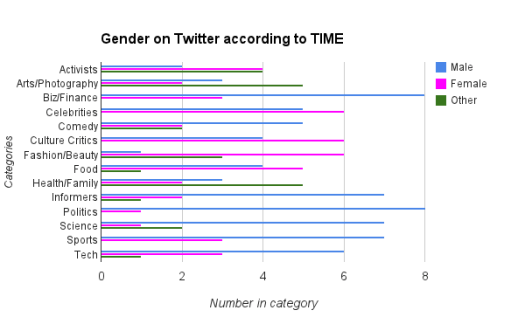
chart_1

Does all this really matter? Probably not, but inclusion on a list like this creates buzz and a certain amount of pop-culture legitimacy. The fact that vast swaths of TIME’s selection are so male heavy is weird, especially when you consider that 60 percent of Twitter users are female.

TIME editors admit the list is “not comprehensive” and invite Twitter users to weigh in with their own favorites using the hashtag #Twitter140. But I can’t help wondering if they could have pushed a little harder to highlight women who meet the criteria of standing “out for their humor, knowledge and personality.”

There’s no dearth of smart women offering pithy political tweets. This crew, for instance, or any of the fine journalists suggested by Carrie Dann of NBC News:

As for science, I’ll bet this spunky social media user has some ideas.

(*A note on my methodology: I broke TIME’s list into three categories: male, female and other. The first two groups are self explanatory. I applied the “other” label to non-gendered accounts, most of which represented institutions. Careful readers will notice that 141 accounts appear on the graphs. That’s because one of TIME’s picks included two names, one male and one female.)
Why I love Zotero and you should too

Source: Zotero
Source: Zotero.org

Career adjustments are almost always laced with stress, especially when they’re made within the context of modern journalism. So when I started grad school last fall, my list of worries was long: figuring out the T, finding enough freelance clients to pay the bills, taking tests and — when it’s all over — finding a job in journalism education.

The one thing I didn’t have to fret over, though, was remembering how to cite research papers. My brother-in-law’s partner is a philosophy professor, and he introduced me to a digital citation tool called Zotero.  It won’t, alas, keep track of which professors like the Oxford comma and which consider it an affront to the English language, but Zotero is a great way to organize the many books and journal articles I’m reading these days.

What sets Zotero apart from other citation managers are its social features, including one that allows users to create shared libraries. Here’s one I’m putting together about women, journalism and digital news.  You should be able to see a list of publications — it’s short now, but there are more titles to comes — add comments, and download documents. It’s also compatible with most RSS readers.

What other publications should I include?