The best Christmas story I ever got to tell

This was the type of bomber 1st Lt. Enoch Perkins flew to Europe in December 1944. Photo/Wikimedia Commons

Seven years ago, I helped tell a Christmas story that will stay with me for the rest of my life. I shared it with my students earlier this month, and I now I’m posting it here.

I’d spent months working with my former boss Mike Pride to interview dozens of local World War II veterans for a series of stories that would eventually become this book. The project focused on the memories of people still living in our community, but we also pulled a handful of narratives from journal entries, poems and letters left behind by veterans when they died.

Such was the case with 1st Lt. Enoch Perkins, who took command of a new B-17 bomber in the final weeks of 1944. Perkins had died about a year before we started our work, but his daughter had a copy of his journal, and she wanted to share some of it with our readers. Perkins was a great writer, and he kept a careful, vivid account of his travels – including an unexpected stopover at Grenier Field in Manchester, NH

Before I go any deeper into the act of human kindness that makes this tale so special, here’s a bit of backstory:

Many of the heavy bombers that helped the Allies win the war were assigned newly-trained flight crews at air fields in the Midwest. Those crews would hopscotch the planes across the U.S., then north to Canada’s east cost. From there, they’d fly to cold, remote airstrips in Iceland and Greenland, eventually landing in Scotland. One of the last places these crews would land on American soil was Grenier.

Perkins remained in Manchester for several days longer than planned because his copilot needed to recover from an ear infection. While he waited, he worked with a few Red Cross volunteers to make sure his crew and, as it turned out, dozens of other airmen would experience some holiday cheer thousands of miles from home.

Here’s the full story as it appeared in the Concord (NH) Monitor. Please take the time to read; you won’t forget it, either.

Service, solutions and theology in local journalism

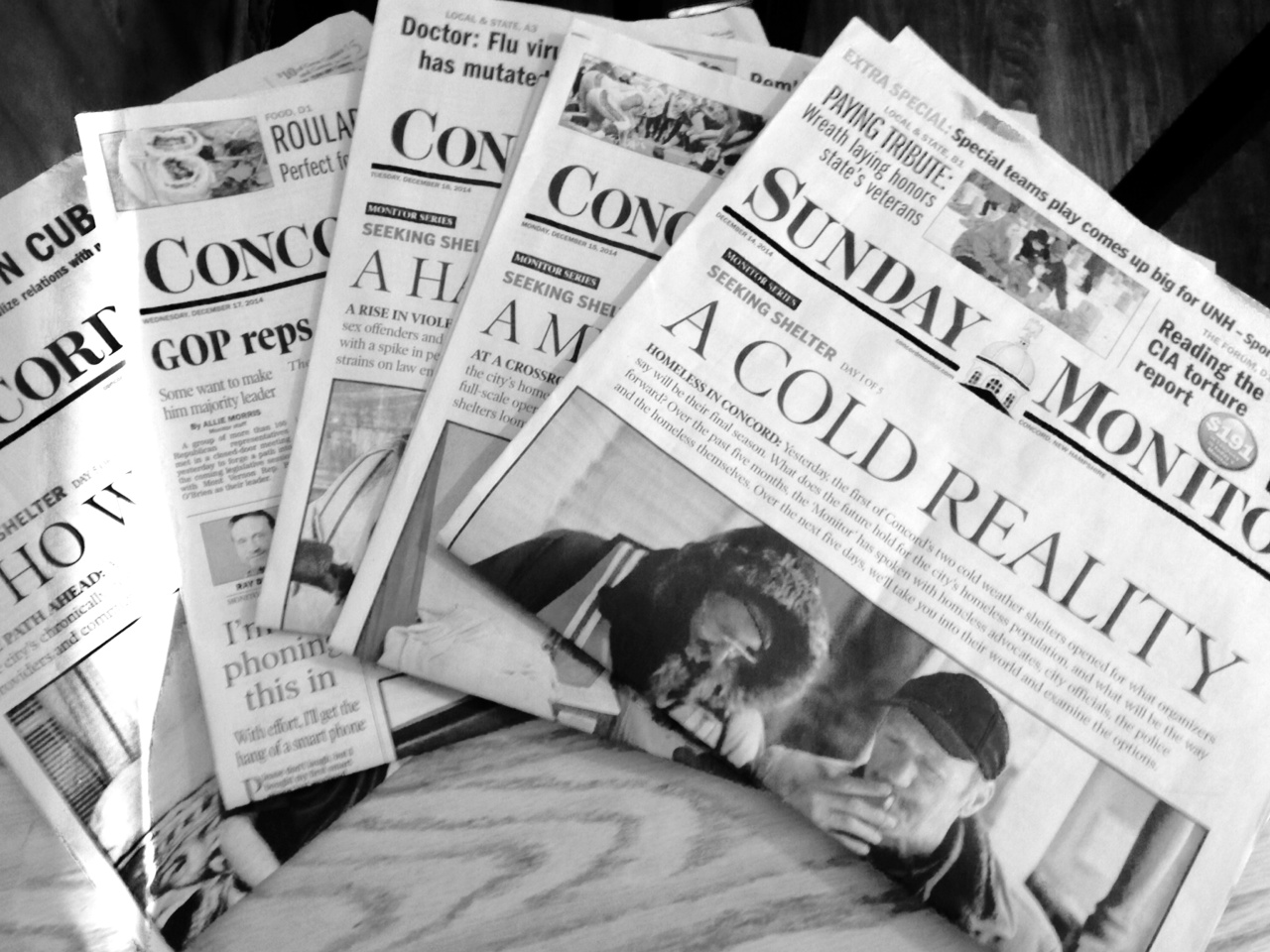
IMG_1007.JPG

I spend a handful of nights each winter in the basement of a downtown church, pouring coffee and passing out dry socks to men and women with nowhere else to go. I’m among the hundreds of volunteers who, for the last decade, have helped operate a cold weather homeless shelter in Concord, NH.

The people we serve there have been the focus of a sweeping collection of stories, photos, graphics and videos published this week by the Concord Monitor*The series, called Seeking Shelter, has given me a lot to think about both in terms of homelessness and the role of local newspapers.

I’ve learned a lot during my volunteer shifts at the shelter, but the Monitor’s series has taught me more. The city, write reporters Jeremy Blackman and Megan Doyle, is at an “unprecedented moment” in its history:

Concord’s homeless population has been growing for years, driven by a mix of economic instability, rising substance abuse and geography. State and local police have broken up many of the encampments in town, following a number of violent incidents and several deaths.

Community leaders have long discussed finding a more permanent solution, but they’ll need to act fast. Come spring, the shelter where I volunteer and a second one at a neighboring church will shut down for good.

The Monitor has addressed homelessness in the past through daily stories, photos and editorials. But this week’s series takes its coverage to a new level, one that bodes well for the practice of local journalism.

In his book The Wired City, Dan Kennedy** asks, “Can journalism have a theology?” He uses that question to explore the motivations and professional philosophy of Paul Bass, the founding editor of the nonprofit New Haven (CT) Independent. That publication’s journalism, Kennedy writes, is

based on a community-driven vision of conversation, cooperation and respect. It is a vision that sounds a lot like that of many religious communities, and it is the opposite of the top-down, we-report/you-read-watch-or-listen model of traditional news organizations.

I’ve been reminded of this passage as I’ve watched the Monitor’s series unfold this week. All of the players – social workers, policymakers, clergy members and the homeless people themselves – are portrayed as human beings facing complex challenges. Photographers Geoff Forester and Elizabeth Frantz earned the trust of the homeless community in a way that allowed them to document the lives of people who often prefer to remain unseen.

Perhaps most importantly, though, the Monitor has explored possible solutions and invited public conversation. Much has been written about the concept of solutions journalism, and the Monitor’s work this week is a good example of the genre. The newsroom also created the hashtag #homelessinconcord to organize online discussion. Tonight, the paper’s editors will host a community dialogue at one of the shelters about the issues raised by the series.

Not that long ago, traditional journalists may have labeled this as something too close to advocacy. It’s not.

Instead, it’s the kind of thing news organizations must do to remain crucial parts of the communities they cover. Kennedy makes this argument in The Wired City, exploring how local editors like Bass can foster as well as cover civic life.

The Monitor isn’t immune to the financial and existential challenges facing newspapers, but this series is an indication that, to the journalists in its newsroom, simple survival won’t be enough. Local news organizations should practice the kind of storytelling happening at the Monitor this week. It will be hard. It will consume scarce resources. And it must happen. No matter what.

Can journalism have a theology?

Yes.

And it’s embodied in the kind of collaborative, socially just and human storytelling displayed by the Monitor this week.

*I worked at the Monitor for many years, and was a consulting editor there this summer. 

** Dan Kennedy was one of several fantastic faculty members who advised my graduate studies at Northeastern University last year. 

Teaching without a net

When it comes to class planning, I’m rather obsessive. I have white boards in my office, a couple of spreadsheets on my hard drive and a notebook for each course I teach. I write detailed memos to my students and myself, and I spend a few days at the beginning of every semester wrestling Blackboard’s grade book into something that resembles order.

But, sometimes, it’s fun to toss all of that aside and just riff. That’s what I did today with a dozen of my journalism students here at UNH. My inspiration was Storybench.org, a new collaboration between Northeastern University’s Media Innovation program and Esquire Magazine. (Disclosure: I received my MA from Northeastern last year. More disclosure: I remain a UNH hockey fan.)

Storybench is as useful as it is gorgeous, jam packed with techniques culled from the front lines of digital creation. Headline generation! Google Maps! Charts and graphs galore! The site formally launched yesterday, and I knew I had to use it in class right away.

Even without a plan.

We’re near the end of the semester up here, and I’d promised my students something a little fun and little different from the usual rhythm of our writing workshop. I talked about the why and when of telling stories with data and showed them a few examples. While they worked on projects in Infogr.am (which I’ve used for more than a year), I announced I would race them to build something similar using Storybench’s instructions for Charted.co – a new tool I’d never touched before today.

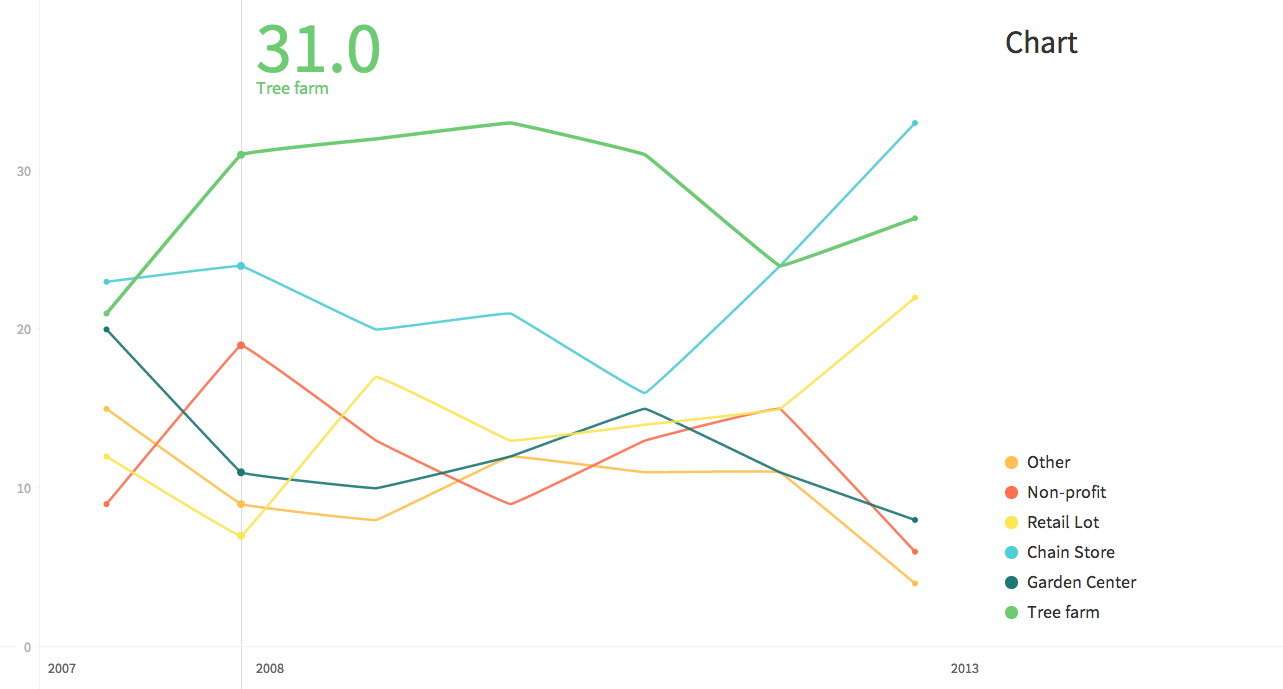
We focused on data about where Americans purchase their Christmas trees. They pasted it into Infogr.am and, before long, were adding pictures and adjusting color palettes.

data

I spent 20 minutes wresting with Google Drive before giving up and putting the .csv file in DropBox. By the time class ended, this half-baked graph was all I had to show:

chart

But the point of activities like this isn’t necessarily a finished project. What matters is introducing young journalists to the concept of real-time experimentation, showing them that it’s okay to dive into something new without knowing exactly where it will lead.