ICYMI: Worried about bias at Facebook? Then worry about this, too.

I wrote a column for USA Today last week exploring why Facebook’s political leanings should be one small part of a broader conversation about the demographics of the people building the social web.  Here’s an excerpt:

Anyone troubled by the notion of bias at Facebook …  should also be upset by its lack of diversity and the homogeneous workforces of many tech companies. These cornerstones of the social web play significant roles in determining what is and isn’t news. If the default worker is white, male, straight and liberal, that increases the risk that journalism’s future will repeat the mistakes of its past.

Read the whole thing here.

#TBT: New Hampshire primary edition

Just when it seemed we’d have to start numbering super Tuesdays like super bowls, the Republican primary is all but over and, although Bernie Sanders will continue his campaign, the Democrats’ delegate math is against him.

I’m still mulling what the outcome of the GOP race says about the state of political journalism and wondering if the general election will go much beyond gender politics. But it seems like a good time to inventory my own coverage of the 2016 primary, which began last April when Jeb Bush brought a couple of key lime pies to Concord:

This was my fourth primary as a journalist and my first since leaving a full-time newsroom gig. That meant I experienced 2016 partly  as a freelancer and partly through the eyes of my journalism students. (About those students: I’m utterly biased, but didn’t they do some fantastic work when the Democratic debate came to UNH in February?)

The journalism landscape changed a lot between 2012 and 2016. I bumped into reporters from the New York Times and CNN, but there were just as many journalists working for BuzzFeed, Vox, Vice and other digital startups.

Meerkat and Periscope made live video a huge part of campaign coverage, allowing the Union Leader to pretty much break the internet with this and giving one of my classes a chance to watch – and question – Hillary Clinton during a Concord Monitor editorial board interview last fall. Wifi was more ubiquitous, even in rural areas, making this primary feel more intense, more scripted, more public.

Instagram has been around since 2010, but this was the first national campaign where it was standard fare. For me, Instagram became an experiment in short-form storytelling, a way to sketch the voices and scenes that give the campaign trail its texture. Here’s one example from that Bush event last April:

Another favorite taken in Bedford the weekend before the primary:

And here’s one from my neighborhood polling station on voting day:


I wrote mostly for the Boston Globe, filing stories about candidate draft movements, political artifacts and campaign technology in 2008 versus 2016. I also met some wonderful new Americans preparing to vote in their very first primary and delved into the mysterious origins of the GOP. I also had bylines in Women’s e-News and the Concord Monitor. And, on primary day, I talked about the state of the political news media on New Hampshire Public Radio.

My best 2016 memory, though, is playing political tourist with my cousin Drew, a government major at UT-Austin. He flew into Manchester the weekend before the primary, and we spent the next few days crisscrossing the state in search of would-be presidents. We saw Bush and Rubio at elementary schools in Concord and Bedford, met Kasich at the Puritan Backroom and watched Cruz address a packed town hall in Peterborough.

In downtown Manchester, we saw campaign finance reformers, wandering journalists and piles of Trump signs ready for a rally and this guy:

DSC_0560

How serving as a Pulitzer juror made me a better journalism teacher

Being invited to serve on a Pulitzer jury is probably a little like getting accepted to Hogwarts: You receive a letter written on really nice stationary with instructions to show up at a certain place and time. And please, it goes on, don’t tell anyone what you’re up to.

My envelope from Hogwarts has, alas, never arrived, but for the second year in a row I was summoned to Columbia University in February to serve as a Pulitzer juror, picking finalists in one of 14 journalism categories.  Last winter, I sat on the local reporting jury. (Details on that experience here.) This time was breaking news.

Pulitzer deliberations are confidential, and jurors’ identities are secret until after the winners are revealed, but my experience has still been a powerful teaching tool, one that’s given me fresh vocabulary to describe what it means to master the craft of modern nonfiction storytelling.

My students have been poking around the new Pulitzer website for a couple of months, identifying strong leads and mulling over what topics make compelling stories. We also talked a bit about the Pulitzers and public service journalism ahead of our Spotlight event earlier this month.

Last week, my editing class watched the announcement of the 2016 winners live:

CgWM4MqXEAA7E6z

Then we examined the winner and finalists in the breaking news category and talked about the hallmarks of effective, responsible journalism in the first few hours of a big story. The students liked how the Los Angeles Times’s winning entry used rumor-busting bullet points to list known facts after the San Bernardino shootings. They found the Baltimore Sun’s interactive timeline useful in understanding the events that led to Freddie Gray’s death. We also talked about how the Post and Courier used a mix of screen grabs to illustrate a video showing the shooting of Walter Scott. (When it came to whether or not to publish the video itself, the students’ opinions were mixed.)

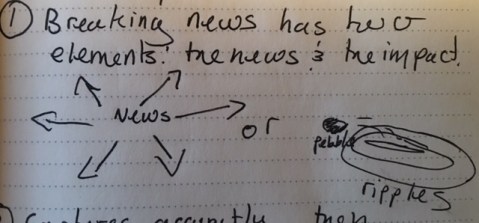
All three entries show a mix of urgency and comprehensive follow up. Here’s a little scribble that I used to illustrate this concept:
FullSizeRender (1)

In the hours, days and even months after a major breaking news event, readers want – need – coverage that provides context, answers questions and explores possible solutions. Accuracy matters more than speed. Or, as I told my students, it’s better to be dead last than dead wrong.

These Pulitzer-inspired lessons will continue in the fall, too. My colleague Tom Haines is teaching a course focused on environmental reporting, and his students will be able to learn from finalists like InsideClimate News, the Portland Press Herald and ProPublica. I’m teaching entrepreneurial journalism, and we’ll talk about how several of this year’s top entires came from news organizations that didn’t exist a decade ago.

So thanks, Pulitzers. And happy 100th birthday. Here’s hoping for another century of identifying and honoring excellence in journalism.