
Learning from “Spotlight”

robbyandme
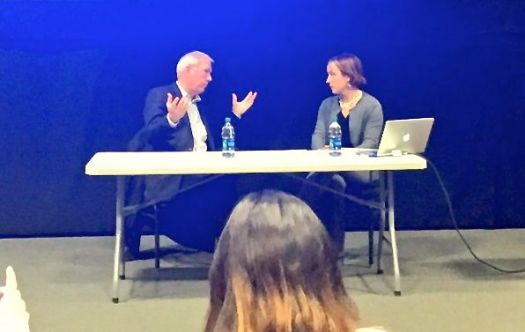
The Boston Globe’s Walter Robinson and I prepare to chat about investigative journalism Tuesday night at UNH. Photo credit/Hadley Barndollar.

During one of the opening scenes in Spotlight, Walter Robinson (as portrayed by Michael Keaton) uses the term “player-coach” to describe his role as editor of the Globe’s famed investigative team. That characterization is accurate – something I know after working as Robinson’s teaching assistant at Northeastern University.

At the time, Robinson was running NU’s investigative journalism program, teaching students how to dig up stories about gun policies at community colleges, racial disparities in Boston firehouses and more. He’s a master at teaching by doing, and, by watching him, I learned as much about running a classroom as I did about mining documents and cultivating sources. (Robinson is back at the Globe now, and NU’s investigative work continues thanks to longtime TV journalist Mike Beaudet.)

It was an honor to interview Robinson in front of an (over) packed room at UNH earlier this week. We talked for an hour or so about the investigation that inspired the Spotlight movie, the importance of access to public information and why knocking on doors is a better reporting technique than sending emails.

Robinson’s visit was the culmination of a series of lessons built around the Spotlight film. And, judging by the conversations I’ve had with students over the last few days, lots of them are inspired to dig just a little deeper on their next stories.



The one with spoilers. So, so many spoilers

My first byline of the year is on this column for USA Today about the many feminist plot points in the new Star Wars movie. It was a lot of fun to write, and my mom got to dig up a photo of kindergartner me wearing a fantastically DIY Princess Leia costume.

princess leia
Getting my girl power on circa 1983. 

The response to the column has been robust and interesting. Here are some of the highlights:

First, strong female role models matter for boys and men, too. For more, check out this great piece by Mike Adamick. And those kinds of characters need to be available on and off the screen. That’s not always the case as evidenced by the blight of female action figures in games and play sets.

Second, one mind-bogglingly successful movie with kick-ass female characters and feminine framing is great – but pop culture remains a boys’ club. This Forbes article provides a good primer, pointing out that “gender discrimination, both in front of and behind the camera and in terms of the kind of stories that get told in cinema, has become so pervasive that the ACLU and the Equal Employment Opportunity Commission has stepped in to investigate.”

Finally, this conversation is about a lot more than space-nerd gossip. Stories matter because they’re one of the chief ways kids learn about social norms and the human condition. Here’s an easy-to-understand rundown of the latest research about the power of narrative in child development.


ICYMI:The pedagogy of the PSL

PSLgrab

I’m spending the final week of 2015 taking stock of the last year, a task that sounds rather lofty but actually involves wrestling with spreadsheets. I did, however, notice that I never shared around here one of the highlights of my fall: a short explainer on how my UNH journalism students mapped fall-flavored treats to learn about non-linear storytelling.

The piece I wrote appeared on Storybench, a must-read project of Northeastern University’s Media Innovation Program. The map my students made was published by The Sound, a fantastic weekly publication covering the New Hampshire Seacoast.