Learning from “Spotlight”

robbyandme
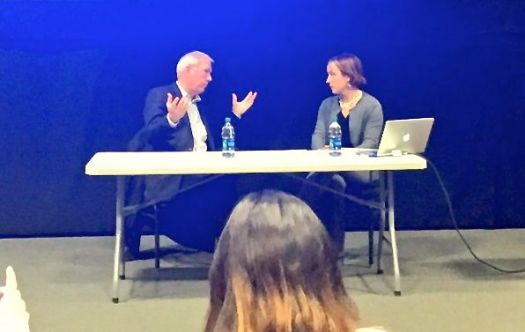
The Boston Globe’s Walter Robinson and I prepare to chat about investigative journalism Tuesday night at UNH. Photo credit/Hadley Barndollar.

During one of the opening scenes in Spotlight, Walter Robinson (as portrayed by Michael Keaton) uses the term “player-coach” to describe his role as editor of the Globe’s famed investigative team. That characterization is accurate – something I know after working as Robinson’s teaching assistant at Northeastern University.

At the time, Robinson was running NU’s investigative journalism program, teaching students how to dig up stories about gun policies at community colleges, racial disparities in Boston firehouses and more. He’s a master at teaching by doing, and, by watching him, I learned as much about running a classroom as I did about mining documents and cultivating sources. (Robinson is back at the Globe now, and NU’s investigative work continues thanks to longtime TV journalist Mike Beaudet.)

It was an honor to interview Robinson in front of an (over) packed room at UNH earlier this week. We talked for an hour or so about the investigation that inspired the Spotlight movie, the importance of access to public information and why knocking on doors is a better reporting technique than sending emails.

Robinson’s visit was the culmination of a series of lessons built around the Spotlight film. And, judging by the conversations I’ve had with students over the last few days, lots of them are inspired to dig just a little deeper on their next stories.


Teaching without a net

When it comes to class planning, I’m rather obsessive. I have white boards in my office, a couple of spreadsheets on my hard drive and a notebook for each course I teach. I write detailed memos to my students and myself, and I spend a few days at the beginning of every semester wrestling Blackboard’s grade book into something that resembles order.

But, sometimes, it’s fun to toss all of that aside and just riff. That’s what I did today with a dozen of my journalism students here at UNH. My inspiration was Storybench.org, a new collaboration between Northeastern University’s Media Innovation program and Esquire Magazine. (Disclosure: I received my MA from Northeastern last year. More disclosure: I remain a UNH hockey fan.)

Storybench is as useful as it is gorgeous, jam packed with techniques culled from the front lines of digital creation. Headline generation! Google Maps! Charts and graphs galore! The site formally launched yesterday, and I knew I had to use it in class right away.

Even without a plan.

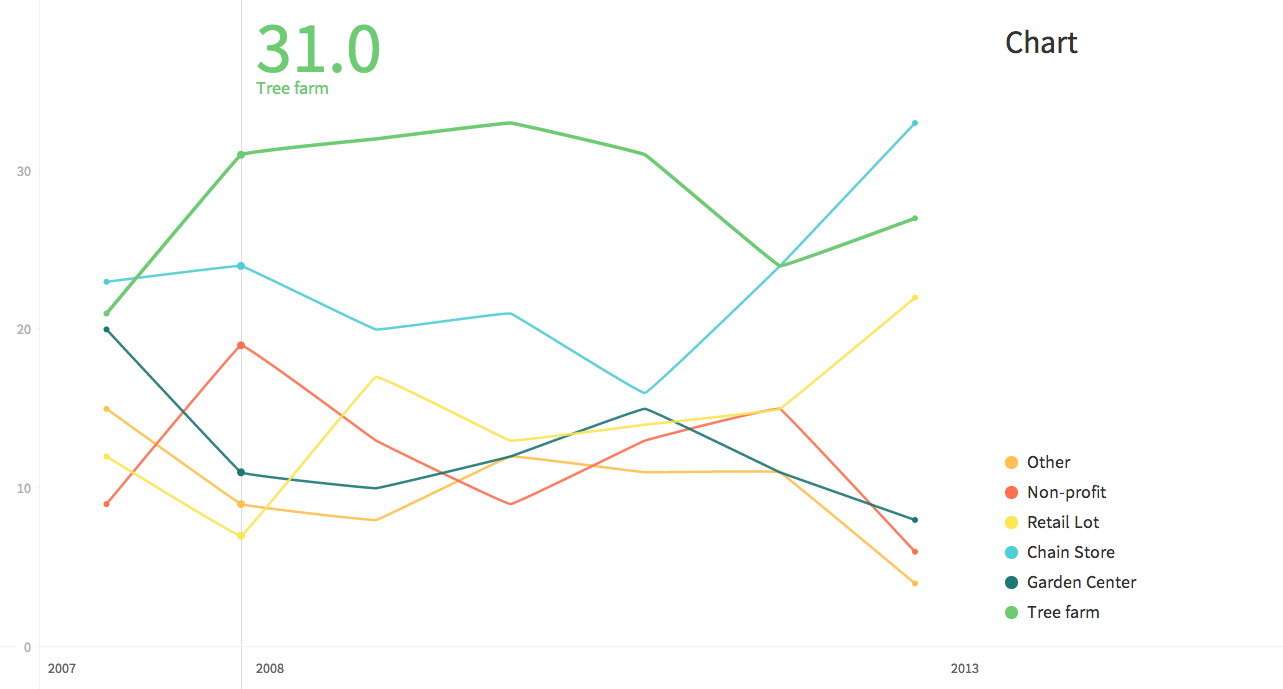
We’re near the end of the semester up here, and I’d promised my students something a little fun and little different from the usual rhythm of our writing workshop. I talked about the why and when of telling stories with data and showed them a few examples. While they worked on projects in Infogr.am (which I’ve used for more than a year), I announced I would race them to build something similar using Storybench’s instructions for Charted.co – a new tool I’d never touched before today.

We focused on data about where Americans purchase their Christmas trees. They pasted it into Infogr.am and, before long, were adding pictures and adjusting color palettes.

data

I spent 20 minutes wresting with Google Drive before giving up and putting the .csv file in DropBox. By the time class ended, this half-baked graph was all I had to show:

chart

But the point of activities like this isn’t necessarily a finished project. What matters is introducing young journalists to the concept of real-time experimentation, showing them that it’s okay to dive into something new without knowing exactly where it will lead.

This is what modern feminism looks like

I’ll post a more detailed account (and photos) of JAWS CAMP soon, but I just couldn’t wait to share this fabulous blog by Northeastern journalism student Susie Blair.

It’s called Femmedia and, as Blair explains in her inaugural post, she hopes to explore the roots of a media culture that often marginalizes women:

I have a complex relationship with the media; a love-hate dynamic. I rely on the media to educate me on a near-daily basis but, as a woman and a feminist, I often become frustrated with how my fellow women are represented, perceived, commodified, ostracized, and stereotyped.

Blair’s blog, like mine, grew out of a class at the Northeastern j-school taught by Prof. Dan Kennedy. It’s also a good example of a topic that came up a few times at CAMP.  There’s often a perception that younger women aren’t interested in feminism, but that’s not true. Their activism just looks different than that of women in previous generations. Instead of marching in the streets, they’re tweeting, launching publications and blogging.

Rosie would be proud:

1380019_10151739949067913_2126807083_n