September and everything after

img_2936
The September 11 and 12, 2001 editions of the Biddeford Journal Tribune, where I worked my first job as a reporter. The Journal Tribune was an afternoon paper, giving the editors time to remake the front page after the attacks began.

Every time I pass through Southern Maine, I’m startled by its openness. There are no roadblocks on the highways or police officers patrolling the bridges. Portland harbor is busy, traffic is often heavy, and airplanes pass overhead. To a casual visitor, there’s little to hint at the shock and fear that descended there 15 years ago.

My tenure as a resident of Southern Maine was brief, but those 11 months are inseparable from one brilliant, blue September day and the grim autumn that followed. To me, it’s a region frozen in time, and even the briefest visit evokes a dizzying disconnect, similar to what happens when I remember my college journalism students were preschoolers when Mohamed Atta boarded an early-morning commuter plane at the Portland Jetport.

When it happened, my college diploma was three months old, and I dreamed of a life as a writer. Late that August, I’d started my first job as a reporter at a little paper in Biddeford, a city about halfway between Portland and the New Hampshire border. I had a shitty apartment in a building that reeked of tobacco and sweat. On most nights, the guy down the hall came home drunk and screaming. I installed yellow contact paper on the backsplash in the galley kitchen, stuffed my bookcases with empty journals I planned to fill and began learning the intricacies of covering city government.

The editors at that paper were the best first bosses I could have hoped for, especially on that day. When we knew the second plane was not an accident, there was no coddling – just assignments and a promise that we would shovel information to our readers until we dropped from exhaustion. A photographer and I crisscrossed the city, stopping at a high school, a department store, a college. We paused downtown, where the streets were silent and drivers wept in pulled-over cars. Later that week, I sat across a kitchen table from a woman who’d escaped one of the towers and come to Maine to stay at her parents’ beach house. I stumbled through my questions, scribbled notes and wondered how long it had taken to wash the dust from her hair.

For a long time, I tried not to think about what that autumn was like for me. I wasn’t in Manhattan or Washington, D.C. or Shanksville. I didn’t know anyone who died. It felt wrong to make myself a protagonist in a story that harmed so many others in so many more devastating ways. My thinking is different now, mostly because of my journalism students. Last year, I walked into a crowded classroom and started a discussion about coverage of the Paris terrorist attacks. The cafes, the theater, the dead and the wounded were on another continent, but my students were frightened in a way that tugged at something deep in me. At some point, they began to ask me about the fall of 2001 the way I ask my parents about Kennedy and Kent State.

Over the years I’ve developed a September tradition of reading E.B. White’s 1949 essay “Here is New York.” It’s a sweeping meditation of the city’s speedy post-war evolution, beautiful, chaotic and, as he writes in this passage, terrifying:

“The city, for the first time in its long history, is destructible. A single flight of planes no bigger than a wedge of geese can quickly end this island fantasy, burn the towers, crumble the bridges, turn the underground passages into lethal chambers, cremate the millions. The intimation of mortality is part of New York now: in the sound of jets overhead, in the black headlines of the latest edition. All dwellers in cities must live with the stubborn fact of annihilation.”

We no longer need to live in physical cities to feel this kind of geographic vulnerability. We spend our days inside a sprawling, digital metropolis of videos and photos. Every place can feel like our place. Paris. San Bernardino. Brussels. Ankara. Orlando. The shattering headlines aren’t one giant break but an evolving tangle of tiny, thread-like fractures.

Two weeks ago, I met a new batch of bright journalism students. I hope we make it through this year without another act of violence that spurs questions about where I was – about who I was – on that day 15 years ago.

That is, alas, unlikely.

When it happens, we’ll look at the news alerts, analyze the credibility of facts, critique the narratives that emerge. If they ask about that time I lived so briefly in Southern Maine, I’ll answer. I’ll also tell them this: We were not annihilated then. By embracing knowledge and compassion and grace, we will not be annihilated now.



How serving as a Pulitzer juror made me a better journalism teacher

Being invited to serve on a Pulitzer jury is probably a little like getting accepted to Hogwarts: You receive a letter written on really nice stationary with instructions to show up at a certain place and time. And please, it goes on, don’t tell anyone what you’re up to.

My envelope from Hogwarts has, alas, never arrived, but for the second year in a row I was summoned to Columbia University in February to serve as a Pulitzer juror, picking finalists in one of 14 journalism categories.  Last winter, I sat on the local reporting jury. (Details on that experience here.) This time was breaking news.

Pulitzer deliberations are confidential, and jurors’ identities are secret until after the winners are revealed, but my experience has still been a powerful teaching tool, one that’s given me fresh vocabulary to describe what it means to master the craft of modern nonfiction storytelling.

My students have been poking around the new Pulitzer website for a couple of months, identifying strong leads and mulling over what topics make compelling stories. We also talked a bit about the Pulitzers and public service journalism ahead of our Spotlight event earlier this month.

Last week, my editing class watched the announcement of the 2016 winners live:

CgWM4MqXEAA7E6z

Then we examined the winner and finalists in the breaking news category and talked about the hallmarks of effective, responsible journalism in the first few hours of a big story. The students liked how the Los Angeles Times’s winning entry used rumor-busting bullet points to list known facts after the San Bernardino shootings. They found the Baltimore Sun’s interactive timeline useful in understanding the events that led to Freddie Gray’s death. We also talked about how the Post and Courier used a mix of screen grabs to illustrate a video showing the shooting of Walter Scott. (When it came to whether or not to publish the video itself, the students’ opinions were mixed.)

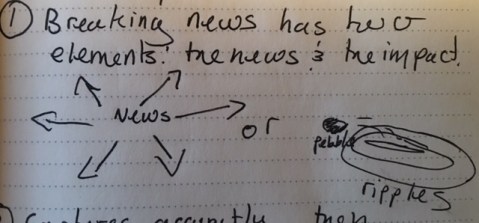
All three entries show a mix of urgency and comprehensive follow up. Here’s a little scribble that I used to illustrate this concept:

FullSizeRender (1)

In the hours, days and even months after a major breaking news event, readers want – need – coverage that provides context, answers questions and explores possible solutions. Accuracy matters more than speed. Or, as I told my students, it’s better to be dead last than dead wrong.

These Pulitzer-inspired lessons will continue in the fall, too. My colleague Tom Haines is teaching a course focused on environmental reporting, and his students will be able to learn from finalists like InsideClimate News, the Portland Press Herald and ProPublica. I’m teaching entrepreneurial journalism, and we’ll talk about how several of this year’s top entires came from news organizations that didn’t exist a decade ago.

So thanks, Pulitzers. And happy 100th birthday. Here’s hoping for another century of identifying and honoring excellence in journalism.

Learning from “Spotlight”

robbyandme
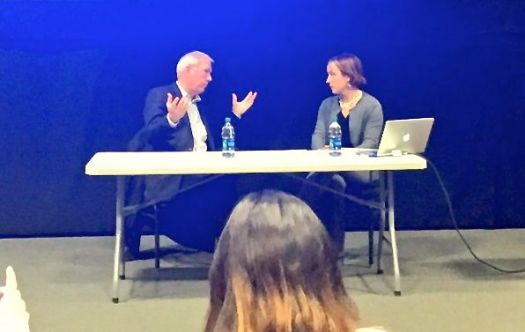
The Boston Globe’s Walter Robinson and I prepare to chat about investigative journalism Tuesday night at UNH. Photo credit/Hadley Barndollar.

During one of the opening scenes in Spotlight, Walter Robinson (as portrayed by Michael Keaton) uses the term “player-coach” to describe his role as editor of the Globe’s famed investigative team. That characterization is accurate – something I know after working as Robinson’s teaching assistant at Northeastern University.

At the time, Robinson was running NU’s investigative journalism program, teaching students how to dig up stories about gun policies at community colleges, racial disparities in Boston firehouses and more. He’s a master at teaching by doing, and, by watching him, I learned as much about running a classroom as I did about mining documents and cultivating sources. (Robinson is back at the Globe now, and NU’s investigative work continues thanks to longtime TV journalist Mike Beaudet.)

It was an honor to interview Robinson in front of an (over) packed room at UNH earlier this week. We talked for an hour or so about the investigation that inspired the Spotlight movie, the importance of access to public information and why knocking on doors is a better reporting technique than sending emails.

Robinson’s visit was the culmination of a series of lessons built around the Spotlight film. And, judging by the conversations I’ve had with students over the last few days, lots of them are inspired to dig just a little deeper on their next stories.