Meet the “Ladies of the Press”

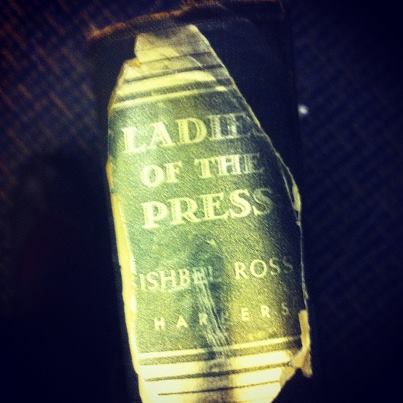
305919_10151390014587913_619961207_nIn 1936, a reporter named Ishbel Ross did something extraordinary when she wrote the first formal history of female journalists. It’s imperfect in many ways:  the book features only white women and Ross devotes many pages to praising reporters who get the story without sacrificing their feminine charm. Still, it’s full of fascinating tidbits, especially a chapter devoted to the rural press.

Nowhere, Ross writes, “is the newspaper woman more active than in country journalism” where she “practically raises her babies in the waste-paper basket, cooks rice pudding to the friendly thud of the linotype or chronicles the town doings from the cracker box stance.” At the time the book was published, Ross counted more than 300 female editors and publishers working at small papers across the United States.

Some of these woman worked alone; others came to power through family ties, operating the papers alongside their husbands or fathers. Many filled their newsrooms with women, just one example Ross cites of how their publications differed from their urban counterparts:

The country newspaper woman has a freedom of expression denied the metropolitan reporter. She can push a local cause, mix freely in political fights, write what she likes and continue her job until she is eighty years of age, if her eyesight is good and she so desires.

BBC creates video database of female experts

The BBC is helping its reporters connect with smart, well-spoken women by assembling a database of female experts. According to The Telegraph, the database includes specialists from a variety of fields who have completed a free media training day organized by the BBC.

The ‘expert women database’ contains the details of the 60 women who have so far received free training via these days, as well as the contacts of a further 120 women who “showed promise” in their applications to the BBC Academy. More than 2,000 women applied for the first BBC Academy female expert training day but there were only 30 spaces.

The BBC is one of several British news organizations responding to criticisms about gender imbalances in journalism.

As the Telegraph reports, this isn’t the first database of its kind. My own quick Google search uncovered this directory of female scientists in Eastern Europe. Are there any similar databases in the U.S.? Should someone start one?

Who else is counting?

I launched this blog to help find meaning in the scads of information I’m gathering for my thesis, which is focused on the role of women in emerging online news organizations. My methodology is still in the works, but I’m lucky to have some fantastic research to build upon. Over the next few weeks, I’m going to create a literature review — a document that describes “the critical points of current knowledge” on a topic.

But it won’t be your typical lit review. There will be video, photos, maybe even an interactive graphic, all designed to help understand what data is available, who’s collecting it and — perhaps most importantly — why. I’ve written already about some of the sources I’ll cite, including this list of blogs and books, a public Zotero bibliography and a post about The Gender Report, a byline surveillance project that’s found an underpresentation of women in online news.

I’m also talking to the Columbia Journalism Review in hopes of gleaning some useful information from its fantastic Guide to Online News Startups. There’s also some interesting research happening at MIT and in conjunction with the Boston Globe’s innovation lab. One or both of those projects could make for interesting video.

Who else should I include?