Here’s where I confess that I first thought Meerkat was somehow related to Mammal March Madness*. It’s not. It’s an app that makes streaming video almost as simple as tapping out a tweet, and yesterday it collided with the world of political journalism. Hard.
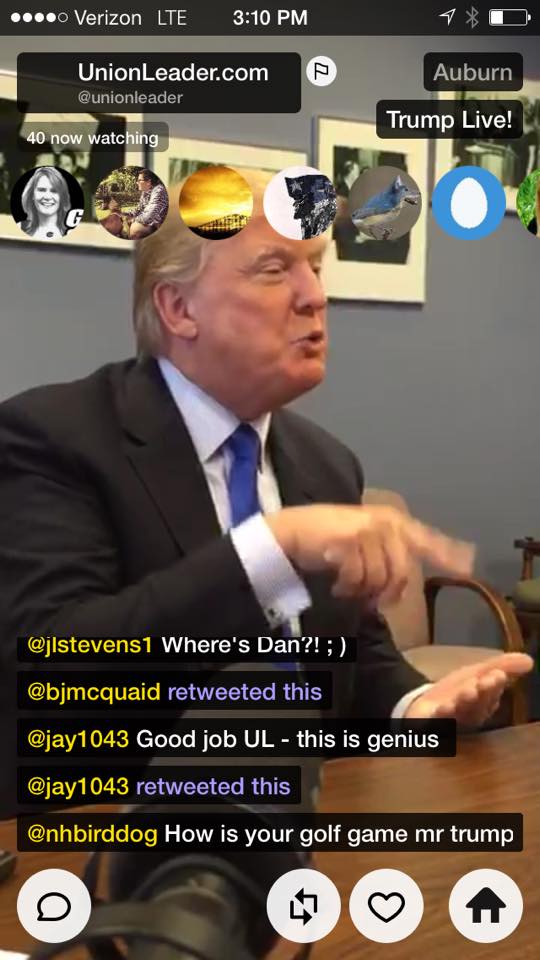
A screen grab from yesterday’s live stream of Trump’s interview with the UL.
The Union Leader has long been a force in Republican politics, something that’s especially apparent during the early months of New Hampshire’s first-in-the-nation primary. Potential candidates stop by the Manchester newsroom for meetings with the UL’s editorial board – the first step towards winning the paper’s coveted endorsement.
Yesterday, that potential candidate was Donald Trump. And the editorial board decided to use Meerkat to live stream the whole thing. I watched for a few minutes, and it looked like at least 50 other people did, too. It wasn’t long before other local news organizations had opened accounts of their own. NECN streamed one of Trump’s campaign stops later in the day, and my iPhone buzzed all night with alerts that other political journalists had opened accounts on the app.
The technology is pretty cool and becoming more common. Meerkat was a huge hit at SxSW, and Twitter recently acquired similar software. There’s also an app called Stre.am that’s gaining traction, although I don’t know much about how it works.
If you want to try it yourself, remember that this is video so all related tips apply: Use an external mic to get the best sound, avoid vertical frames and, as one local reporter suggested to me on Facebook, consider getting a tripod if you’ll be streaming for long periods of time.
I suspect Meerkat and similar tools will become standard fare on the campaign trail – a new window into real-time politicking and a reminder of how fast the practice of journalism is changing.
*If you don’t know about Mammal March Madness, stop reading this blog immediately and click here for deets.
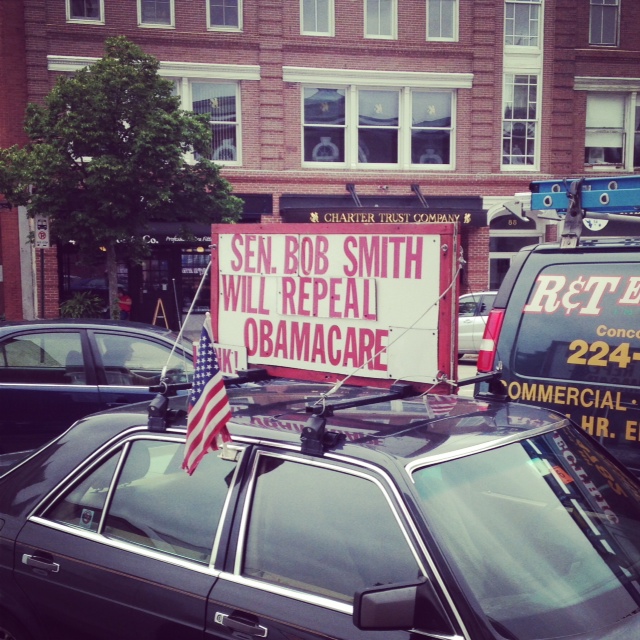
One of the many political opinions on display lately. Photo/Meg Heckman
It’s been a decade since the bitter cold winter when I started covering politics. Plenty of Democrats wanted a chance to unseat President George W. Bush, so New Hampshire was bustling with candidates. It was a rare stump speech that didn’t reference 9/11, and most voters I met knew at least one person stationed in Iraq or Afghanistan. Everyone who turned out to hear the potential challengers or, later, the president himself believed that this election would somehow make things better.
Sure, politics has plenty of problems. There’s too much money. Too much celebrity. Too much disconnect between the loud debates and the everyday lives of most Americans. But the political process is also beautiful. A campaign is a microcosm of a community: coalitions, networks, passions that bring people together and drive them apart. In the months before an election, voters become more public with their anger, their fears, their hopes. They display their opinions on lawns, on car bumpers and with pins on their lapels. Collectively, we consider who we are to ourselves and who we want to be in the eyes of the world.
And, as a journalist on the campaign trail, it was my job to find them at their coffee shops and their town halls, flip open my notebook and listen.
When I decided on the career shift that would eventually land me a teaching job at UNH, I assumed I was done covering politics. I was wrong. Which is awesome. Because I really missed it.
Since early June I’ve been filing dispatches from New Hampshire for the Boston Globe’s new political section, a visually stunning effort called Capital that appears Fridays in print and throughout the week online. (Here’s Poynter’s take on the project, and a look at the section’s design philosophy.) Capital was great when it launched, and it’s only gotten better since then.
 Meg Heckman